
5th International Andrology Symposium
5th International Andrology Symposium
Faruk Hadziselimovic
Cryptorchidism research institute, Liestal, Switzerland
Correspondence: Dr med em. Faruk Hadziselimovic Bahnhofplatz 11,4410 Liestal Switzerland
Combining histology, endocrinology, and transcriptomics, this paper presents molecular proof that mini-puberty failure—not malposition alone—causes infertility in many cryptorchid boys. GnRH agonist therapy (e.g. buserelin) restores the expression of genes involved in germ-cell maturation (NHLH2, PRDMs, and PIWI/TDRD pathways), thereby re-establishing mini-puberty. We argue that early surgery should be complemented by individualized hormonal therapy as a fertility-preserving intervention in a biopsy-selected subset of cryptorchid boys.
Keywords Cryptorchidism, RNA sequencing, GnRHa treatment, Mini-puberty, Infertility
En combinant histologie, endocrinologie et transcriptomique, cet article démontre que l’infertilité chez de nombreux garçons cryptorchides découle d’un échec de la mini-puberté plutôt que d’un simple problème de position. Le traitement par agoniste de la GnRH restaure l’expression de gènes clés de la maturation germinale (NHLH2, PRDM, PIWI/TDRD) et réactive la physiologie de la mini-puberté. L’auteur préconise une approche personnalisée, guidée par la biopsie, associant chirurgie précoce et traitement hormonal ciblé pour préserver la fertilité.
Mots-clés : Cryptorchidie, Séquençage d’ARN, Analogue du GnRH, Mini puberté, Infertilité
Cryptorchidism is one of the most common congenital disorders among men, and is a leading cause of subfertility and infertility, even after technically successful orchidopexy. Convergent clinical–molecular data have reframed cryptorchidism as being not merely a problem of malposition but rather a disorder of postnatal testicular maturation. Specifically, in cases of cryptorchidism, mini-puberty fails to trigger the gonocyte → Ad (dark) spermatogonia transition, which is the foundational stem-cell event enabling lifelong spermatogenesis. (1- 4) My group and others have demonstrated that the presence of Ad spermatogonia during early childhood predicts normal adult sperm output, whereas their absence portends oligozoospermia/azoospermia, even after timely and anatomically successful surgery [1–4].
Parallel transcriptomic studies from cryptorchid testis biopsies have identified actionable molecular derangements, including blunted expression of genes that govern mini-puberty signaling (e.g. NHLH2), PRDM histone methyltransferases, PROK/ EGR/ PITIX and PIWI/TUDOR/MAEL/DDX4 transposon-silencing machinery, which can be rescued by GnRH agonist (GnRHa; buserelin) therapy [4–6]. Even when orchidopexy is performed within current guideline windows, adult fertility remains compromised, especially in cases of bilateral cryptorchidism [2 ]. The historical treatment model was purely surgical: bring the gonad to the scrotum early, to reduce malignancy risk and “protect” spermatogenesis. However, longitudinal follow-up and semen data have revealed a different reality: if mini-puberty has failed, anatomical relocation alone does not reprogram the immature testis [1–3].
Mini-puberty encompasses the transient activation of the hypothalamic–pituitary–gonadal (HPG) axis in males from ~2 weeks to 3–6 months of age, which drives Leydig cell testosterone and Sertoli cell proliferation (AMH and inhibin B) and, crucially, promotes the first postnatal maturational step: transformation of centrally located gonocytes into Ad spermatogonia along the basement membrane [1–3]. Failure of this step leads to truncation of the stem-cell pool that seeds later spermatogenesis; although the testis may look “normal” in size and even descend with surgery, their fertility potential has already been impaired [1–3]. This insight suggests that such cases may benefit from targeted hormonal treatment to reinstate mini-puberty biology.
In this paper, we review the molecular evidence that has accrued since the 1970s and been refined through contemporary transcriptomics, which supports GnRHa treatment as a rational disease-modifying therapy in a biopsy-selected subset of cryptorchid boys.
In landmark analyses, boys who underwent early orchidopexy and testicular biopsy were followed into adulthood, with semen testing. The presence of Ad spermatogonia (Ad+) at the time of surgery predicted normal total sperm counts in ~94% of cases, whereas absence of Ad spermatogonia (Ad−) predicted abnormal spermiograms in ~92% of cases, despite technically successful surgery [1, 2]. In subsequent series, Ad spermatogonia status was validated as a discriminating factor for fertility outcome, and a characteristic deficiency of the gonadotropin luteinizing hormone (LH) was highlighted as an endocrine signature of compromised mini puberty in many cryptorchid males [2, 3,4] (Fig. 1).].
Orchidopexy only corrects position and cannot trigger the gonocytes → Ad transition or restore a missed mini puberty. Both the treatment timing and adequate biological correction are important. Surgery is necessary to minimize the risk of malignancy and mechanical sequelae, and hormonal intervention is also required to modify the germ-cell fate trajectory [1–5].
Cryptorchid boys with high infertility risk histology (HIR; Ad−) display molecular signatures of attenuated mini-puberty[2,5,6]. Among genes identified as involved in idiopathic hypogonadotropic hypogonadism and descent biology, nescient helix-loop-helix 2 (NHLH2) mRNA is uniquely decreased in HIR biopsies and robustly increased after GnRHa therapy, positioning NHLH2 as a plausible controller of mini-puberty that may link neuronal (hypothalamic) activity to testicular responses [6].
Our earlier placental studies demonstrated elevated estradiol in placentas from mothers of cryptorchid boys compared to controls, suggesting that a prenatal hormonal milieu may derail germ-cell programming. [7]. Viral infections (e.g. Zika) have also been associated with cryptorchidism in affected cohorts, and research in this field continues to disentangle infections per se from hormonal/placental pathways [8].
In primordial germ cells, epigenome erasure and re-establishment are orchestrated by PRDM family histone methyltransferases and master regulators (e.g. SOX17 and PRDM1/BLIMP1). HIR cryptorchid testes exhibit downregulated PRDM transcripts and pluripotency/PGC programs, which increase after GnRHa treatment [5].
Concomitantly, components of the PIWI–TUDOR–MAEL–DDX4–GTSF1 axis—which silence retrotransposons and protect genome integrity in the germ line—are impaired in HIR cryptorchid testes and partly restored with therapy [9]. Overall, these data suggest that hormonal rescue occurs not only due to steroidogenesis but also via epigenome repair and reactivation of genome defense.
Transcriptome-profiled biopsies of HIR cryptorchid testes reveal that administration of GnRHa (buserelin) for ~6 months induces broad changes in genes involved in hormonal response, steroidogenesis, and Sertoli–Leydig crosstalk [2,5,]. The unique up-regulation of NHLH2 following treatment suggests that the neuronal GnRH pathway entrains testicular gene networks, constituting a bridge between central pulsatility and peripheral germ-cell maturation [6].
PRDM family members (e.g. PRDM9) mark recombination hotspots and, more broadly, coordinate chromatin states. HIR cryptorchid testes exhibit downregulated PRDM mRNAs, which rise after GnRHa therapy—providing molecular evidence that treatment re-engages histone methylation programs that are germane to stem-cell identity and meiosis readiness [ 5].
In HIR cryptorchid testes, long non-coding RNA (lncRNA) expressions are perturbed, and shifts toward Ad+-like profiles after GnRHa treatment. Notably, GnRHa therapy leads to upregulation of BOD1L2, a candidate participant in the maintenance of spermatogonial stem-cell programs [10]. Together with restoration of PIWI pathway components (transposon silencing), these changes imply that hormonal therapy induces network-wide stabilization of the germline transcriptome [10].
Clinically, compared to surgery alone, successful hormonal–surgical management is associated with more normal epididymal development. [11].Molecular work from our group suggests that GnRHa can influence androgen-sensitive epididymal genes, and that CFTR-related pathways may intersect with LH/fibroblast growth factor (FGF) signaling in cryptorchidism-related azoospermia [12,13]. While further research is needed to validate involvement of the CFTR axis, the initial data align with epididymal pathologies observed in inadequately treated cases
Across cohorts, risk is stratified by Ad spermatogonia status at orchidopexy: Ad+ children have a high likelihood of normal adult semen, while Ad− children carry a high risk of severe spermatogenic failure without additional therapy [1–4]. Importantly, this differentiation is maintained even with early and technically successful orchidopexy [1–4]. These data support the importance of routine testicular biopsy during orchidopexy at specialized centers—both as a prognostic tool and as therapeutic triage for GnRHa [1 4].
In our long-term follow-up of HIR (Ad−) boys treated with GnRHa after surgery, the majority exhibited rescued adult fertility, compared with similarly staged untreated controls [2,14]. These results are consistent with the molecular re-engagement of mini-puberty programs and germline protection. On the other hand, HIR cases treated with surgery alone exhibited catastrophic sperm counts in adulthood [2,14].
Virus-induced endocrinological effects on male sexual development could explain a potentially critical component of cryptorchidism. This proposed model is consistent with some of the relevant physiological and seasonal data and applies to all viral infections that affect estrogen levels in placental cells. [15].
An elevated odds ratio for low IQ has been found for cryptorchid boys. [16,17]. Furthermore, poor school performance has been observed in cryptorchid boys with impaired mini puberty. [16,17]. One unanticipated signal in our datasets is that HIR patients with and without GnRHa treatment show differential expression of neuronal genes linked to memory and cognition [18,19]. Impaired expression of genes, EGR4, FMR2 (AFF2) and VCX3A,known to encode proteins involved in signaling pathways that regulate cytoskeletal organization, synaptic vesicle transport and the establishment of connections between neuronal cells may contribute to reduced intellectual and cognitive functioning in infertile cryptorchid males. This corresponds with historical observations of LH deficiency (Fig. 1), and with reported cognitive differences in cohorts that exhibit HPG axis disruption in infancy. The shared genetic toolkit of the brain and testis, along with the dual neuronal–testicular role of NHLH2, offer a coherent biological framework for the systemic reach of mini-puberty and its failure [19]. GnRHa treatment augments LH and testosterone secretion and induces testicular expression of various genes involved in long-term memory formation, in particular RASGRF1 and EGR2. [19]. RASGRF1 plays a key role in regulating the RAS signaling pathway and is important for long-term memory formation. [19]. No positive effect is detectable in “surgery only” patients [19].
This biopsy-guided approach does not mean that every patient should receive hormone treatment, but rather involves precision medicine grounded in histology and molecular reversibility.
The last half-century of cryptorchidism research has overturned the notion that outcome is dictated by position alone. The decisive variable is whether the testes have experienced the mini-puberty program and completed the gonocytes → Ad spermatogonia transition. Biopsy-proven absence of Ad spermatogonia predicts adult infertility, regardless of early surgical success. However, crucially, molecular evidence shows that this state is reversible with GnRHa treatment. The post-therapy restoration of NHLH2, PRDMs, EGRs and PIWI/TUDOR/MAEL/DDX4/GTSF1 pathways, and reparative lncRNA shifts provides strong biological and clinical evidence justifying hormonal treatment for selected cryptorchid boys. If the goal is fertility preservation, “surgery-only” paradigms should be replaced with routine biopsy-guided decision-making and early endocrine–surgical collaboration. Based on the presently available evidence, hormonal treatment, when judiciously applied to biopsy-selected patients, is not an embellishment—it is pathophysiology-congruent, fertility-preserving therapy.
CFTR: Cystic Fibrosis Transmembrane Conductance Regulator; DDX4/25: DEAD-Box Helicase 4/25; DMRTC2: DMRT-Like Family C2; FGFR1: Fibroblast Growth Factor Receptor 1HIR: High infertility risk group. NHLH1/2 Nescient helix loop helix ;PIWIL 1–4: Piwi-Like RNA-Mediated Gene Silencing 1–4
Acknowledgments thank long-standing collaborators in Liestal, Basel, and across Europe and the Americas; our patients and their families; and our colleagues who helped us to debate and refine these concepts.
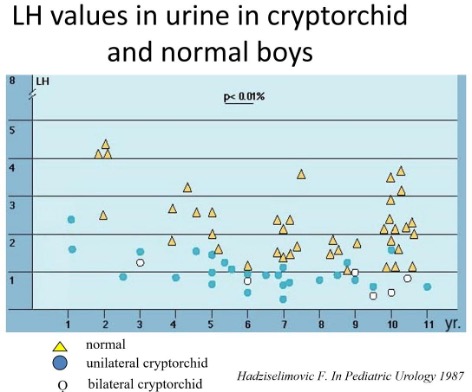
Fig. 1 Lower luteinizing hormone (LH) levels in first morning void urine from prepubertal cryptorchid boys. Triangles: Healthy control boys. Blue circles: Unilateral cryptorchid boys. White circles: Bilateral cryptorchid boys. Pediatric Urology Eds Retick A, Cukier J Williams & Wilkins 1987. p 271.

Lorem ipsum dolor sit amet consectetur. Id mollis nulla maecenas at vestibulum blandit consectetur. Vulputate libero turpis diam eu rhoncus arcu. Donec at imperdiet viverra ut eu sagittis nunc volutpat. Sem nisi turpis venenatis non sed adipiscing donec dignissim.