
5th International Andrology Symposium
5th International Andrology Symposium
Faruk Hadziselimovic
Cryptorchidism Research Institute, Liestal, Switzerland
Correspondence: Dr med em. Faruk Hadziselimovic Bahnhofplatz 11,4410 Liestal Switzerland
The descent of the male gonad is a coordinated morphogenetic journey of the epididymo-testicular unit, not of the testis in isolation. A century of schematic drawings placed the gubernaculum at center stage, but histology, comparative embryology, and translational studies have indicated that the epididymis precedes and “leads” the testis into the scrotum, with the gubernaculum primarily creating the path and providing space rather than “towing” the testis. This paper synthesizes molecular, anatomical, and clinical evidence supporting this epididymis-first concept and revisits classic experimental data to integrate modern insights on INSL3/RXFP2 signaling and androgen action. I also discuss how dissociation anomalies between the epididymis and testis, as well as a failure of epididymal smooth muscle/myofibroblast maturation, can arrest descent despite apparently intact gubernacular morphology.
Keywords: Gubernaculum, Embryology, Epididymis, Hypogonadotropic hypogonadism, GnRHa
La descente du testicule est un processus morphogénétique coordonné de l’unité epididymo-testiculaire, et non un processus isolé du testicule. Pendant un siècle, des schémas ont placé le descente du testicule est un processus morphogénétique coordonné de l’unité épididymo-testiculaire, et non un processus isolé du testicule.
Pendant un siècle, des schémas ont placé le gubernaculum au centre de ce processus. Or, l’histologie, l’embryologie comparée et les études translationnelles indiquent que l’épididyme précède et « guide » le testicule dans le scrotum, le gubernaculum jouant principalement un rôle de guide et de création d’espace, plutôt que de tirer le testicule. Dans cet article, je synthétise les données moléculaires, anatomiques et cliniques – y compris les travaux de mon équipe – qui soutiennent ce concept de l’épididyme en premier ; ‘intègre les connaissances modernes sur la signalisation INSL3/ RXFP2 et l’action des androgènes. J’aborde également la manière dont les anomalies de dissociation entre l’épididyme et le testicule, ainsi que l’échec de la maturation des muscles lisses/myofibroblastes épididymaires, peuvent arrêter la descente malgré une morphologie gubernaculaire apparemment intacte.
Mots clés: Gubernaculum, embryologie, épididyme, GnRHa, Hypogonadisme hypogondotrope
Generations of pediatric surgeons learned that the gubernaculum is the “holy grail” of testicular descent. The narrative, which was popularized by elegant but oversimplified diagrams, envisions a ligament that shortens, pulls, and anchors the testis into the scrotum. However, histology sections, scanning electron microscopy, and cross-species comparisons challenge this picture.
Three biologic observations frame the issue:
These observations, updated in my comprehensive review on the epididymo-testicular unit (ETU) [2-4], argue that the epididymis is the active locomotor and steering element of descent, whereas the gubernaculum provides the permissive environment (gelatinous extracellular matrix, expansion of the canal).
The cauda epididymis advances ahead of the testis, “bulldozing” the way into the future scrotum; the testis follows, cradled by the everted epididymal tail and mesentery. By postnatal day 3, the ETU is largely scrotal, and the gubernacular “cord” is thin; there is no histologic evidence of strong traction marks on the testis at that stage [2-5]. Testicular form, such as that in human shows flattening of the upper testis pole due to caput epididymis pressure (Fig 1).
Human fetal series at 20–30 weeks of gestation exhibited a bulky, hydrated gubernacular cone occupying the inguino-scrotal corridor and was rich in extracellular matrix and fibroblasts. Gubernacular fibers merge into epididymal connective tissue, not into the tunica albuginea; the processus vaginalis invaginates through this mass. The testis rides behind the enlarging epididymal tail, consistent with epididymal-led descent [2-4] (Fig 1).
Bergh et al. (1978) cut the gubernaculum at different levels in rats and found that cutting the distal gubernaculum (blocking formation of the processus vaginalis) prevented descent, whereas severing proximally did not, if the scrotal pathway still developed [5]. Contemporary reviews have echoed this reinterpretation and emphasized gubernacular expansion in humans as a key step during the inguino-scrotal phase [2-4].
The canonical two-phase model is transabdominal (placental hCG; INSL3 from fetal Leydig cells) and inguino-scrotal (androgen-dependent) and remains broadly valid [4]. The deeper insight is where these signals act:
In INSL3-deficient mice, epididymal development is aberrant and the ETU fails to descend properly, implicating epididymal maturation as a functional readout of the INSL3 pathway [3]. This epididymal smooth muscle axis offers a mechanistic bridge between endocrine cues and physical descent [6]. In 2010, we reported impaired FGFR1 expression in the undescended testis of unilateral cryptorchid boys [7]. In addition, decreased FGFR1 protein levels have been found in cryptorchid epididymides of both humans and rodents [7]. These findings support the involvement of FGFR1 in regulating epididymal mesenchyme development. The impaired FGFR1 protein secretion found in underdeveloped mesenchyme in cryptorchid humans and rodents likely contributes to the defective epididymis formation and consequent undescended position. Thus, the observed decrease in FGF expression may result in decreased EGR gene expression, inducing congenital hypogonadotropic hypogonadism and maldescent of the ETU [7].
The gubernaculum swells, becomes extracellular matrix-rich, and dilates the inguinal canal/processus vaginalis, stabilizing the ETU as it traverses the abdominal wall. Distal interruption (failure of processus formation) blocks descent even if endocrine signaling is intact [5]. Thus, no path means no passage. Our gubernacular definition in accordance with van de Broeck explicitly excludes the conus inguinalis observed in rodents (but missing in humans) as a gubernaculum [8]. Furthermore, we consider the distal part of the gubernaculum a scrotal anlage with different physiological functions in different mammalian species [8].
Histology does not show a robust fibromuscular cable inserting into the tunica albuginea to pull the testis. Instead, the epididymal tail advances first and, with androgen-primed myoid elements along the epididymal duct and mesentery, the testis follows, cradled by the epididymal curve and mesorchium. In this ETU model, the gubernaculum is the door-opener and the epididymis the pathfinder and mover [1,2].
A recurring problem has been didactic schemata that paste the gubernaculum directly onto the testis and omit the epididymis. When checked against histology plates, these images do not match reality because the gubernacular fibers blend with epididymal connective tissues and vasal mesentery, and the testis lacks traction footprints one would expect if it were a primary target of a shortening “tendon” [4,9,10,11]. The community should prioritize image-backed anatomy over iconography.
The accumulated molecular, experimental, and anatomical evidence supports an integrated model in which the epididymis leads and the gubernaculum enables. The epididymal tail descends first, the gubernacular mass opens the route distally, and the testis follow as part of an ETU.
Bergh A, Helander HF, Nilsson O. Studies on factors governing testicular descent in the rat. Int J Androl. 1978;1:177-86. doi.org/10.1111/j.1365-2605.1978.tb00605.x
Hadziselimovic F, Adham IM. Insulin 3-like hormone and its role in epididymo-testicular descent. Int Braz J Urol. 2007;33:290-5. doi: 10.1590/s1677-55382007000300015.
Hadziselimovic F. Involvement of fibroblast growth factors and their receptors in epididymo-testicular descent and maldescent. Mol Syndromol. 2016:261-7. doi: 10.1159/000444033.
Broek AJP. van den, Urogenitalsystem. In: Handbuch der vergleichenden Anatomie der Wirbeltiere (ed. Bolk L, Goppert E, Kallius E, Lubosch W), Berlin: Urban & Schwarzenberg; 1933, pp. 1-154.
Fiegel HC, Rolle U, Metzger R, Gfroerer S, Kluth D. Embryology of the testicular descent. Semin Pediatr Surg. 2011:170-5. doi: 10.1053/j.sempedsurg.2011.03.007.
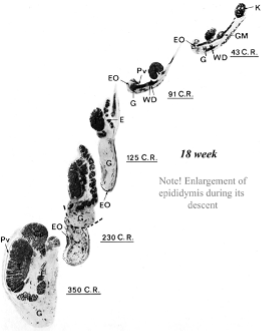
Figure 1. Epididymo-testicular descent in humans. The gubernaculum (G) is proximally attached to the Wolffian duct (WD) and cauda epididymis (E). The mesenchymatous gubernaculum enlarges from the 125 mm crown rump (CR). The epididymis enfolds the testis while descending and pushes the testis down. The caput epididymis pressure induces flattening of the upper testicular pole, particularly at the 350 mm CR. GM, mesonephros; EO, external oblique; K, kidney. [4]
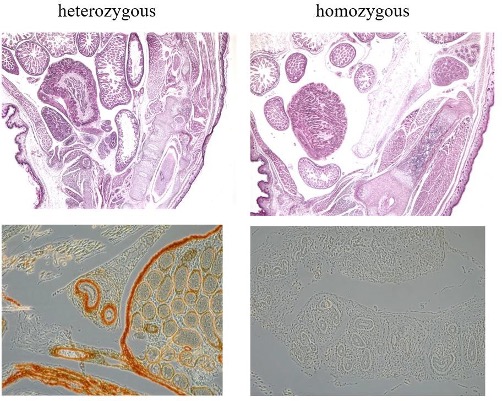
Figure 2. Sagittal section of a heterozygous Insl3 mouse. (a) The testis is located at the bladder neck with developed cauda epididymis. The arrow points towards the gubernacular bulb, where the tip of the gubernaculum is inserted. (b) Immunostaining of the cauda epididymi shows strongly stained smooth muscle arranged in a circular fashion around the epididymal duct (arrow). The tunica albuginea and testicular peritubular connective tissue are also stained. Sagittal section of a homozygous Insl3 male mutant mouse with epididymis and testis located in proximity to the lower kidney pole. The cauda and corpus of the epididymis are underdeveloped. Smooth musculature is absent around the epididymal duct in Insl3 homozygous male mutant mice. [6]

Lorem ipsum dolor sit amet consectetur. Id mollis nulla maecenas at vestibulum blandit consectetur. Vulputate libero turpis diam eu rhoncus arcu. Donec at imperdiet viverra ut eu sagittis nunc volutpat. Sem nisi turpis venenatis non sed adipiscing donec dignissim.